What is Tokenized Real Estate: A Beginner's Guide
Tokenized real estate does not pay you rent by default. We pulled the numbers: $226.44M on-chain against $393.3 trillion of world property.
Paul Tostevin, director of Savills World Research, and his team put a number on the world's property: "At the end of 2024, global real estate was valued at $393.3 trillion." That makes it the biggest store of wealth on the planet, by a distance. We pulled the public registry at rwa.xyz on 26 August 2026, and the slice of all that sitting on a blockchain came to $226.44 million. Call it 57 cents for every million dollars of property on Earth, split between 19,360 owners.
So the question isn't whether tokenization has taken over property, because it plainly hasn't. The question is what those 19,360 people actually bought. Tokenized real estate is property-related rights issued as digital tokens on a shared ledger, so those rights can be held, priced, and transferred electronically.
Read that again and notice what it doesn't promise: not rent, not a buyer when you want out, and not a vote on anything. What you own is whatever the paperwork underneath says, because nothing arrives by default. The token carries the right, the paperwork defines it, and the market is still working out what it's worth.
Key Takeaways
Tokenized property is tiny next to the thing it points at. $226.44M sat on-chain on 26 August 2026, against $393.3 trillion of world real estate at the end of 2024.
A token pays you nothing on its own, because money only reaches you if the asset is genuinely earning and the structure is built to pass it on. Both need to be true, and plenty of tokenized properties haven't been built yet.
Banks got here first and at scale. J.P. Morgan's Kinexys unit had settled "more than $3 trillion in transactions since inception" by 28 April 2026, "averaging more than $5 billion daily."
Holders are arriving faster than traders. Over the 30 days to 26 August 2026, the value grew 11.6% and holders 3.7%, while the addresses that actually transacted fell 21.6%, to 848.
The market is smaller than its own headline, because one property holds $92.3M of that $226.44M, which puts 40.8% of the money in a single asset.
None of that helps you until you can tell which tokenization someone is talking about, and the word is doing four different jobs across four different industries. Most of what you'll read blurs them into one. That is where the confusion starts, so that is where we start.
Which Tokenization Are You Actually Reading About?
In payments, tokenization is substitution. Mastercard describes it as turning "your 16-digit card number into a different number stored on your device, so your actual card information is never shared." That is accurate, and it is far too small a picture of what banks do now, because banks tokenize money itself: deposits, collateral, settlement. J.P. Morgan's Kinexys unit put a number on that on 28 April 2026, reporting more than $3 trillion settled since launch at more than $5 billion a day. So the word does two jobs in one industry. At the till it hides a number; inside the bank it moves real money on a ledger, and only that second job is anywhere near what property people mean.
In software, tokenization is preprocessing: a language model splits text into tokens, the units it can actually read, before any of its machinery runs. Same word, nothing to do with ownership.
In finance, tokenization is issuance. As Itai Agur wrote in the IMF's Finance & Development in September 2025, tokenization "creates assets on a programmable ledger, a recordkeeping system for financial transactions that market participants can trust and share access to." Look at his verb. Creates. A fund manager who tokenizes $3 million of listed shares hasn't filed a copy of them somewhere; she has issued something new that trades on-chain as a token. Process and product share one name, which is why the word feels slippery.
Real estate tokenization is that finance meaning, pointed at buildings. So what does it actually get you?
What Is Real Estate Tokenization?
Real estate tokenization is the issuing of property-related rights as digital tokens on a shared ledger, so those rights can be held, priced, and transferred electronically.
Notice what that does not say. It doesn't say you own part of a building. Fractional ownership is a choice, not a definition, and dividing an asset into small units is a separate decision a seller can make once it's been tokenized, which is why a whole building can be one token with one owner.
And the token isn't the building. Think of it like a ticket: the ticket gets you the seat; the ticket is not the seat, and if the airline folds, you're holding paper.
The obvious pushback is that a share isn't a factory either, and nobody goes around calling shares fake. Fair enough, and that's the right comparison, because it's why any of this works at all. The difference is what sits behind the paper. When a listed company fails, there is a bankruptcy court and a few centuries of case law about what shareholders get, whereas the company holding a tokenized building is usually a few years old and the case law behind it is thin.
What you own is what the paperwork says, and that sounds obvious right up until income comes up. Most people new to this assume a property token pays them rent, and it doesn't. Money only reaches you if the asset is genuinely earning and the structure is built to pass it on. Earning means a paying tenant and something left after costs, and built to pass it on means the documents oblige the owner to hand that money over rather than leaving it to choice. Both need to be true, and plenty of tokenized properties are a patch of land or a half-built block that pays nobody anything.
Rent, an exit, a vote: each one has to be written in on purpose by whoever set the thing up. So who sets it up, and how?
How Does Real Estate Tokenization Work?
Only the last part needs a blockchain, and in practice there are more moving parts than any short summary suggests. A company is set up whose only job is to own the building; then the building is valued, surveyed, and documented the same way as in any normal sale, and this slow part is where most of the real work happens. Then tokens are issued that stand for rights in that company, with the rules about who may hold them written alongside. Depending on the asset and the country, the offering also has a legal classification, eligibility checks on who may buy, custody of the deed, and reporting that runs as long as the asset is held.
Now the catch. The token points at the company and the company owns the building, so if that company fails, the token can't conjure a building out of thin air. Two layers, and only one of them is on a chain.
Buying and selling property runs 5% to 6% of its value once you count every fee, and a good chunk of that pays people to check records against each other, which a shared ledger makes cheap. Settlement changes too, because a programmable ledger can hand over the rights the same instant the money lands. And reach changes, since a building in one country can be held by a buyer in another, subject to local rules, which is what makes selling in smaller pieces a real option.
Worth saying who pockets that saving, though. Cheaper checking is not a lower price for you; it means the people who used to do the checking get paid less, and whether any of it reaches a buyer depends on who is selling. The company holding the building has its own costs every year, and somebody pays those too.
None of that needs a busy market to be useful. Whether one is coming is a question the numbers can answer.
How Big Is Real Estate Tokenization, Really?
Small, growing, and quieter than the headlines suggest. We pulled the registry at rwa.xyz on 26 August 2026, and it showed $226.44M of tokenized property across 105 assets in 11 countries, held by 19,360 addresses. Against the $38.30 billion of all tokenized assets, property is under 1% of what's on-chain, and against the $58.5 trillion of world commercial property, per Savills, it rounds to 0.0004%.
The market is also smaller than its own headline number.
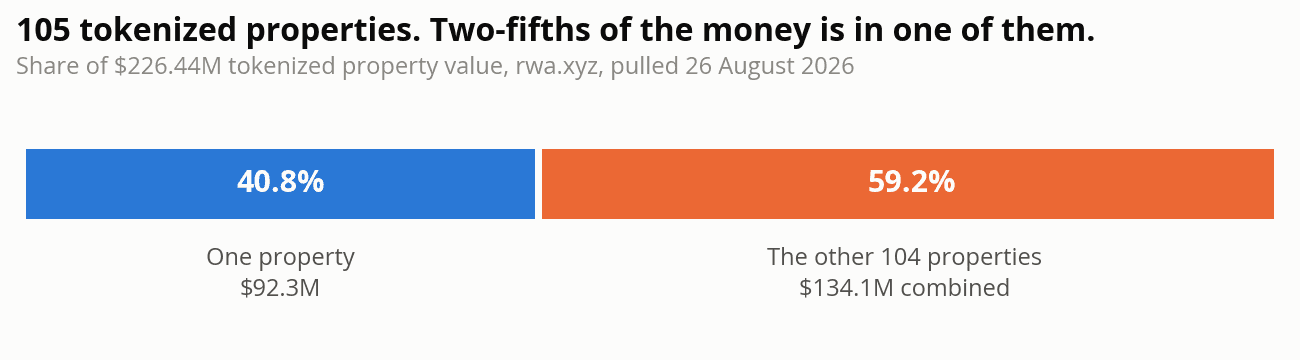
Figure 2. Two-fifths of all tokenized property value sits in a single asset. Source: rwa.xyz, pulled 26 August 2026.
One property holds $92.3M of that $226.44M, so take it out, and the other 104 come to $134.1M between them.
Here is the finding that cuts against the growth story.
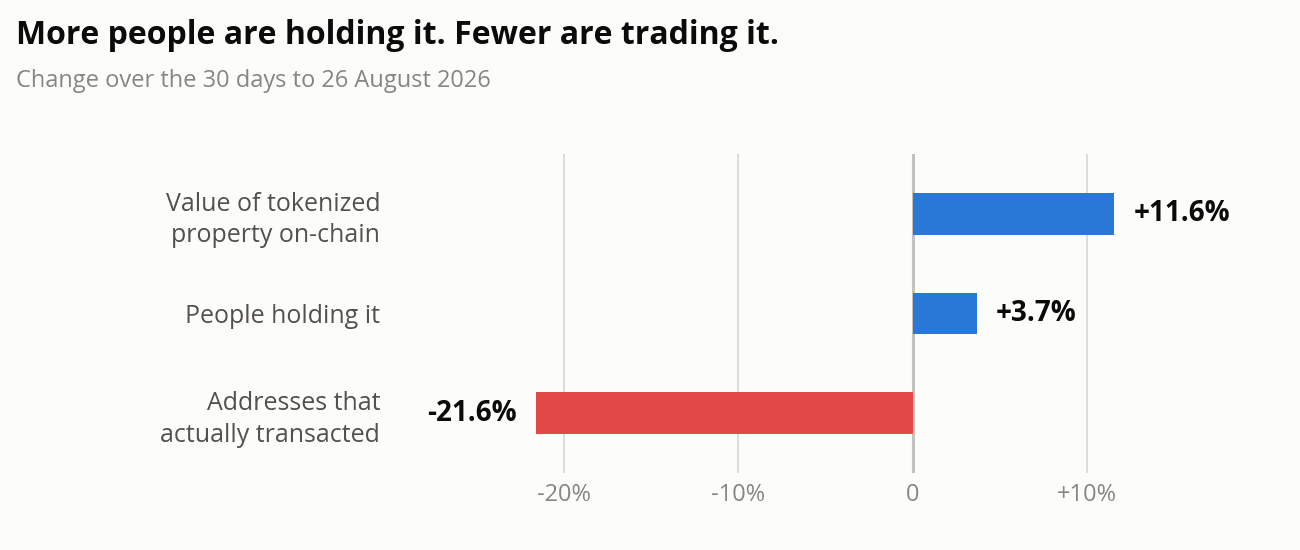
Figure 1. Value and holders are both up over the month. The number of addresses that actually transacted is down 21.6%, to 848. Source: rwa.xyz, pulled on 26 August 2026.
Over the same 30 days, the value grew 11.6%, and holders grew 3.7%, while the addresses that actually transacted fell 21.6%, to 848. People are buying in and then sitting still. Lily Liu, president of the Solana Foundation, put it in one line: most of these are "assets with value but no price because they don't trade." Chris Yin, co-founder of Plume Network, is blunter, saying that "simply tokenizing does NOT lead to liquidity and efficiency for assets." Even McKinsey, which is broadly positive on the category and puts tokenized market capitalization near $2 trillion by 2030, crypto and stablecoins aside, admits that "despite the big predictions, it hasn't yet caught on in a meaningful way."
Now the counter-argument, and it's a good one. Property has never traded much, and nobody expects a building to change hands every month, so judging this market by trading volume is judging it by the wrong thing. Fair. And here's the part that cuts against our own headline: 848 addresses is a thin base to draw a line through; a 21.6% fall is roughly 230 addresses, and at that size one month is noise rather than a trend. What it is not is evidence of the busy market everyone keeps predicting.
The other counter-argument is that every market looks like this at seven years old. Deloitte's Center for Financial Services expects $4 trillion of real estate to be tokenized by 2035, up from under $0.3 trillion in 2024. Tim Coy at Deloitte, one of the report's authors, is honest that the number rests on "a meta-analysis of several total global real estate market size forecasts" rather than on anything measured. Plumbing does get built before the traffic shows up. But read the fine print.
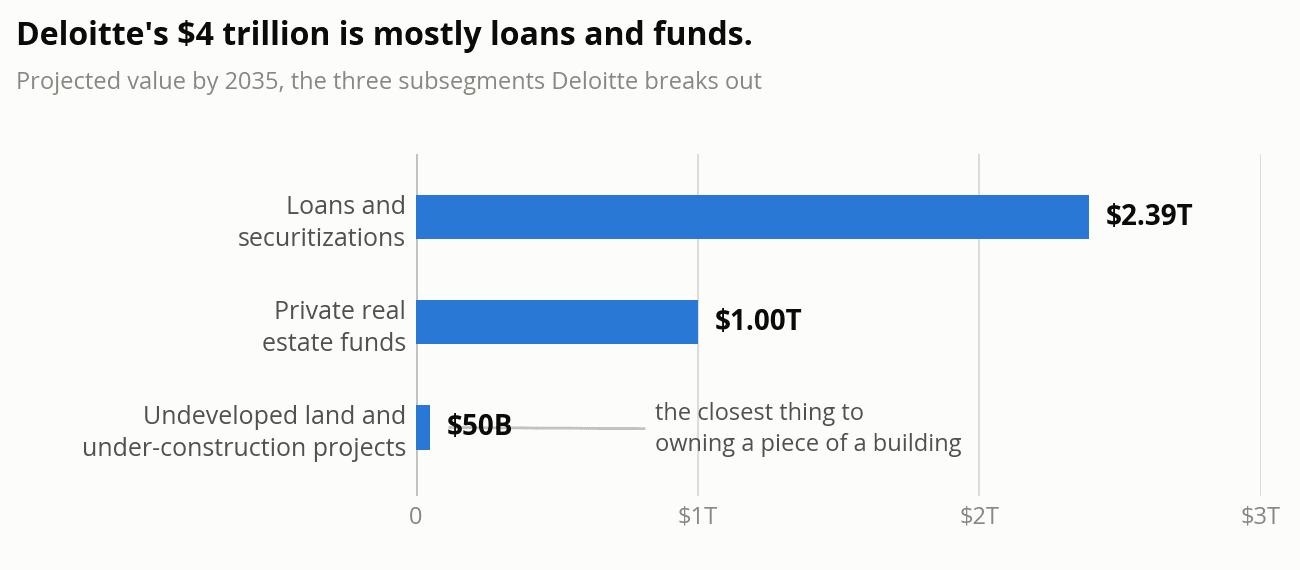
Figure 3. The subsegment closest to owning a piece of a building is the smallest line in the forecast. Source: Deloitte Center for Financial Services, 2025.
$2.39 trillion of that forecast is loans and securitizations, and $1 trillion is private real estate funds, while "the tokenized ownership of undeveloped land and under-construction projects is expected to reach US$50 billion by 2035." That last line is the version most people picture when they hear the word, and it is the smallest one in the forecast.
Forecasts aside, what decides whether this goes well for you is duller than any of it.
What Should You Check Before You Go Near It?
Due diligence starts with the rules. Is the platform regulated, and by whom, both where you are sitting and where the platform itself is based, since a license in one country is not a license everywhere? And where is the asset, because a firm licensed in one place while selling assets in another may be sitting outside the rules that would protect you. Then the offering itself. What exactly would you own: a share in the company that holds the building, a loan secured against it, or a claim on a slice of income? If income is mentioned, is the building actually earning, and is the structure obliged to pass it on? And how would you get out, and to whom?
Fees need their own pass. A good platform shows you the net figure after costs, not just the gross, and fees that are hard to find tell their own story.
This is general information about how the rules are shaped, not legal or financial advice, and none of it tells you what applies to your situation.
Where This Leaves It
Further along than the skeptics say, and earlier than the headlines suggest. The issuing part works today: rights in a building, held as a token, moving without a fortnight of letters. What hasn't shown up is the crowd, and $226.44M against $393.3 trillion says it is still almost entirely outside.
Three things would change that answer. Whether 848 climbs back, whether that $92.3M property stops being two-fifths of the whole market, and whether any of Deloitte's $50 billion land line turns into something an ordinary person can buy.
So when someone tells you a building has been tokenized, you now know the three questions that sentence leaves open. What you'd own, whether it earns, and who you would sell it to. Ask those, and you'll be ahead of most of the people writing about it.
Methodology and Gaps
Market figures come from the public registry at rwa.xyz, pulled on 26 August 2026. World totals are Savills World Research estimates for end-2024, published in October 2025, and the settlement figures are J.P. Morgan's own, published on 28 April 2026. We opened all three source pages on 26 August 2026 and checked every figure against them.
Two things these numbers can't show you. The registry counts addresses rather than people, so one owner holding three wallets counts three times, which makes 19,360 an upper bound rather than a headcount. And an active address can't tell a genuine sale apart from someone moving tokens between their own wallets, so 848 is a ceiling on real trading rather than a measure of it.
Frequently Asked Questions
What Is Real Estate Tokenization?
Real estate tokenization is the issuing of property-related rights as digital tokens on a shared ledger, so those rights can be held, priced, and transferred electronically. The tokens stand for rights in a legal structure that owns the property, so they are not the property itself.
How Do You Tokenize Real Estate?
A company is set up to own the property, the property is valued and documented, and tokens are then issued to represent rights in that company. In practice, there are more stages than that, including the offering's legal classification, eligibility checks on who may buy, and custody of the deed.
Does A Tokenized Property Pay You Rent?
Not automatically. Money only reaches you if the asset is genuinely earning and the structure is built to pass it on. Both need to be true, and many tokenized properties have not been built yet.
Is Tokenized Real Estate The Same As Owning A Share Of A Building?
No. Fractional ownership is a choice, not a definition, and dividing an asset into small units is a separate decision a seller can make once it's been tokenized. A whole building can be one token with one owner.
Is This The Same Tokenization That Protects My Credit Card?
Same tool, opposite job. Card tokenization hides a number so a shop never sees it, while property tokenization records a right so everyone can see who holds it.
How Big Is The Tokenized Property Market?
$226.44M worldwide, across 105 assets in 11 countries, held by 19,360 addresses as of 26 August 2026. It grew 11.6% over the previous thirty days, which is under 1% of the $38.30 billion of tokenized assets overall.